Fast-Drying Hair Dryers for Thick Hair: Airflow, Not Watts, and the Method That Halves Your Time
Hair Tool Specialist, 15 Years
8 min read
Thick hair dries fastest with a dryer that moves a lot of air — a brushless motor, a concentrator nozzle, ionic or infrared to help water leave the hair — and a method that rough-dries to 80% before you pick up a brush. Wattage on the box tells you almost nothing. Airflow and technique are what cut a 40-minute dry to 20.
If you have thick hair, you already know the problem. Forty minutes with the dryer, arm aching, and the underneath layer is still damp. Most of the emails I get about dryers are some version of "which one is the most powerful?" — and the honest answer is that "powerful" is the wrong question. Here's the right one.
Why does thick hair take so long to dry?
Two reasons, and only one of them is about the dryer.
The first is density. Thick hair holds more water per square inch of scalp, and the hair on the inside of a dense section is shielded from the air by the hair on the outside. You're not drying a surface, you're drying a volume. Air has to get into the hair, not just onto it.
The second is method. Most people start with a round brush on wet hair, section by section, from the top. On thick hair that means you're spending the first twenty minutes doing a slow, careful blow-dry on hair that's still 100% wet — the stage where a brush does nothing but stretch it. The dryer isn't slow. The order of operations is.
Fix the second and you'll cut your time before you buy anything. Fix both and you're at half.
What actually makes a dryer fast?
I covered wattage in the infrared dryer post — short version, every dryer sold in the US runs on the same 110–120 V outlet and tops out around 1,875 W, so a "2,500 W" badge is marketing, not physics. What separates a fast dryer from a slow one is how much air it moves and how efficiently it turns power into heat that reaches the hair.
Motor. A brushless DC motor (you'll see it written BLDC) spins faster and more consistently than the old brushed AC motors, weighs a fraction as much, and lasts years longer. It's the single biggest difference between a dryer that feels like a leaf blower and one that feels like a hair dryer. All three CROC dryers use one.
Airflow. This is the number that matters and the one almost nobody prints. The Zero moves 86.4 cubic metres of air an hour — that's the spec that turns a 1,600–1,700 W dryer into something that dries thick hair faster than the 1,875 W dryer it replaced on my bench.
Heat that penetrates. Infrared heats the water in the hair rather than the surface of the hair. Thick hair, where the water is deep in the section, is exactly where that shows up. The Masters 2K2 and the Bumbee Spectrum both use it; the Zero uses an ionic generator instead, which breaks water droplets up so they evaporate faster.
The nozzle. A concentrator nozzle focuses airflow into a narrow, fast stream. Without it, the air spreads and slows before it reaches the inside of the section. For thick hair the nozzle is not optional — it's the second half of the motor.
Weight. Thick hair means a long dry. A 0.9-pound dryer in your hand for twenty minutes versus a 1.5-pound one is the difference between finishing and giving up with the back still damp.
Which CROC dryer is best for thick hair?
Three dryers, three answers depending on what you're doing.
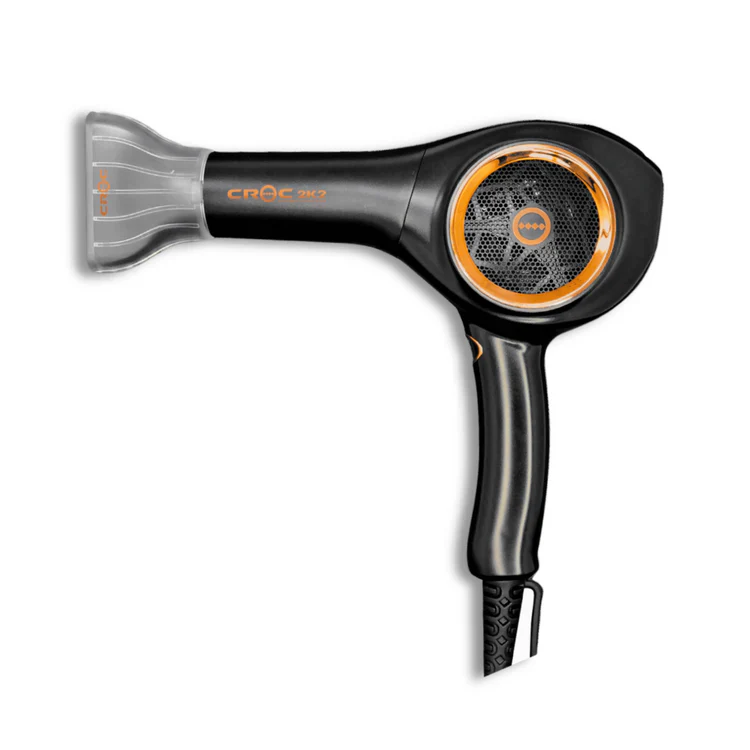
Masters 2K2 Digital Infrared — the full-power salon dryer. 1,875 W, brushless motor, sixteen heat and speed combinations, infrared heating element, heat-proof nozzle and cool shot. If your hair is thick and long, and you blow-dry from wet more than three times a week, this is the one. The sixteen settings matter on thick hair because you'll want high speed with medium heat for the rough-dry and lower speed with higher heat for the finish — and most dryers only give you two of each.
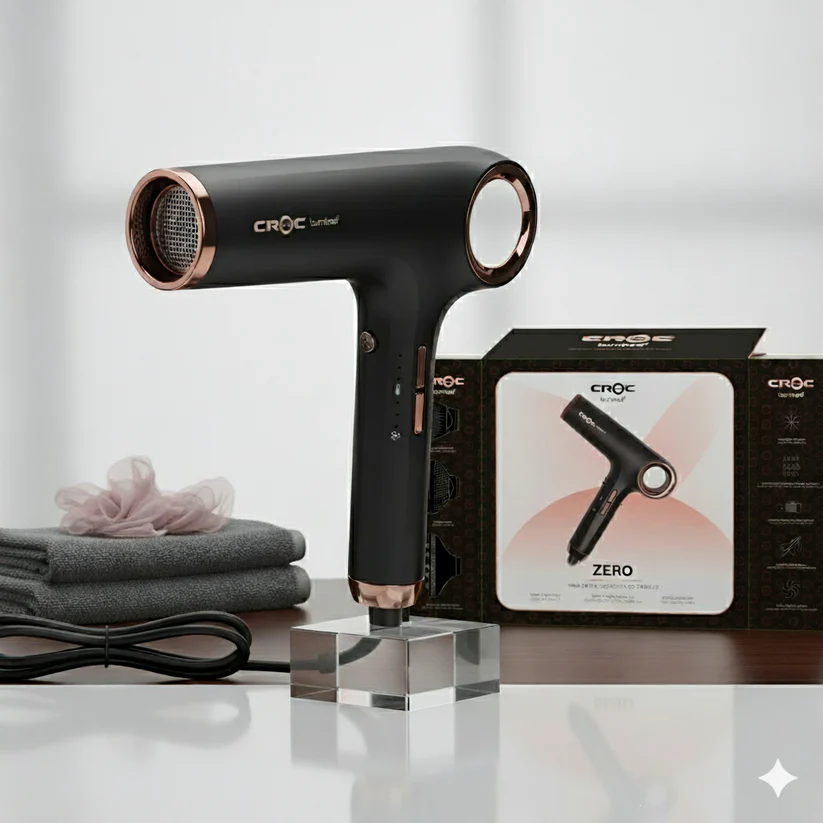
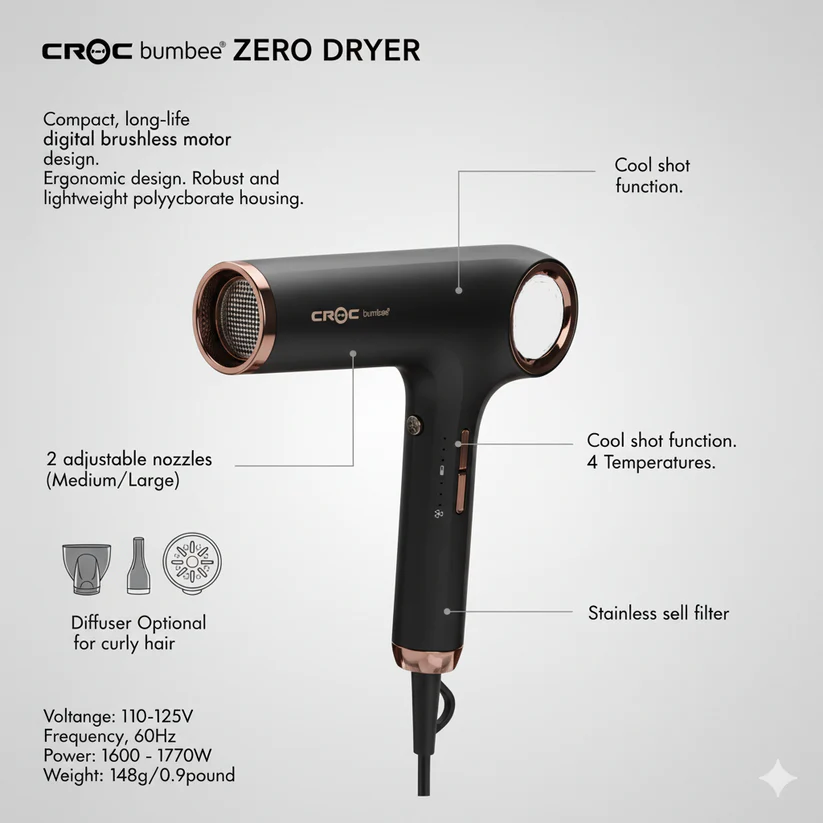
Zero — the fast, light one. 1,600–1,700 W, the 86.4 m³/h airflow I mentioned, brushless, ionic, and 408 grams — 0.9 lb. Four heat settings plus cool shot, two concentrator nozzles (medium and large) in the box, and an 8.8-foot cord. If arm fatigue is the reason your blow-dry never gets finished, this is the answer. It's also the one I'd take travelling.
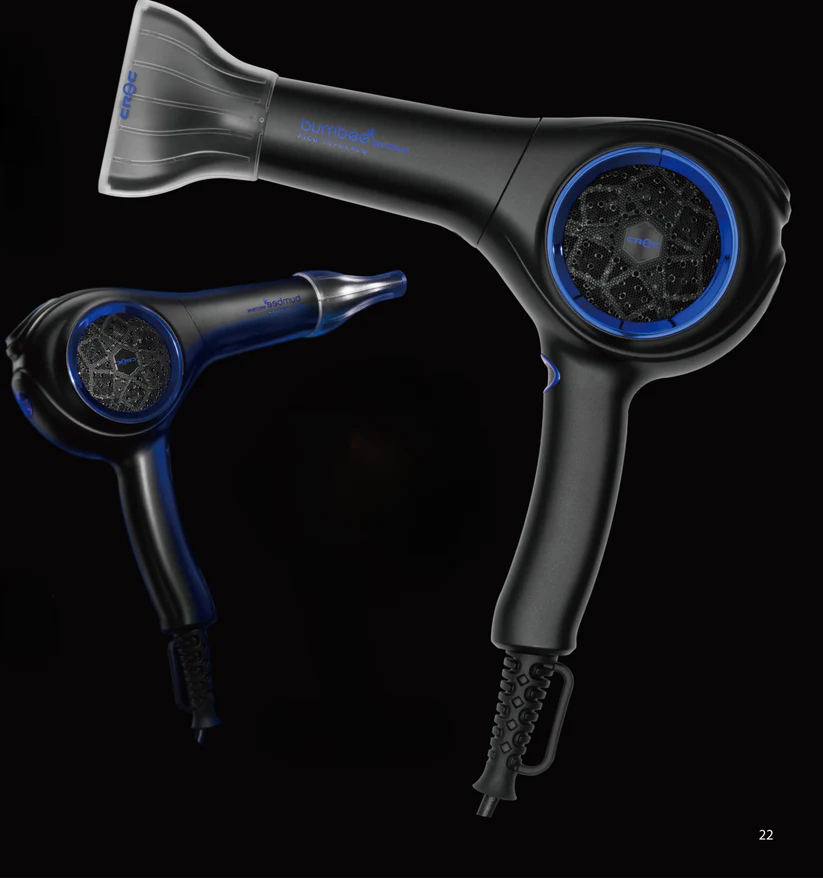
Bumbee Spectrum Pico Infrared — brushless, far-infrared ceramic-coated elements, accurate temperature control. Sits between the two on power and adds precise heat regulation, which is what you want if your thick hair is also colour-treated or prone to frizz. (It also has a pet mode — lower heat, quieter — which isn't why you'd buy it but makes it the one dryer in the house everyone uses.)
If you're not sure: thick and long → Masters 2K2. Thick and you hate the weight → Zero. Thick and damaged or frizz-prone → Spectrum.
What's the fastest way to blow-dry thick hair?
This is the part that actually saves you the time. Five steps.
1. Get the water out before you start. Blot with a microfibre towel or an old cotton T-shirt — not a rough terry towel, and not rubbing. Two minutes of blotting is five minutes of drying you don't have to do. If you use a leave-in or heat protectant, put it in now, on damp hair, so it's spread through the section before heat touches it.
2. Rough-dry to 80%, no brush, no nozzle. Highest speed, medium heat. Flip your head, lift the hair at the roots with your fingers, keep the dryer moving. You're doing nothing careful here — you're just getting the bulk of the water out of the volume. On thick hair this is most of the drying time and it goes fast because you're not fighting a brush. Stop when the hair is damp, not wet: it should feel cool and slightly heavy, not drippy.
3. Section into four. Two clips. Top and bottom, left and right. Four sections is enough; more than that and you lose time moving clips. Start with the bottom sections — they're the ones that end up damp when people skip this.
4. Nozzle on, brush in, heat up, speed down. Now you're styling, not drying. Medium-high heat, medium speed, nozzle pointed down the hair shaft from root to end — never up, that's what lifts the cuticle and makes frizz. Round brush or paddle brush, section no wider than the brush. Three or four passes per section, then move on.
5. Cool shot to set. Last pass on each section with the cool button held. Ten seconds. It closes the cuticle and locks the shape. This is the difference between a blow-dry that lasts one day and one that lasts three.
Twenty minutes on thick shoulder-length hair with a brushless dryer and a nozzle. Longer hair, add five. If you're still at forty, it's almost always step 2 being skipped.
Does infrared or ionic matter for thick hair?
Yes, and for thick hair specifically it's worth more than for fine hair.
Both technologies are about getting water out faster without turning the heat up. Ionic generators put negative ions into the airflow, which break water droplets into smaller ones that evaporate quicker and cut static. Infrared heats the hair from the inside of the section rather than the surface, so the water deep in a thick section gets heat it would otherwise never see.
On fine hair, the difference is minutes. On thick hair, where a normal dryer spends half its time re-heating the outside of a section that's already dry to reach the wet inside, it's the difference between the method above working and not. If you're choosing between two dryers and one has infrared or ionic and one has neither, that's your tiebreaker.
FAQ
What wattage hair dryer is best for thick hair?
Any professional dryer on a US outlet tops out around 1,875 W, so wattage won't separate them. Look at the motor (brushless), airflow, and whether it has a concentrator nozzle. The CROC Zero at 1,600–1,700 W dries thick hair faster than most 1,875 W dryers because of its airflow.
Is a brushless motor worth it for thick hair?
Yes. It's lighter, quieter, moves more air, and lasts longer than a brushed motor. For a long blow-dry the weight alone is the reason.
Should I use the hottest setting on thick hair?
No. High speed, medium heat for the rough-dry; medium-high heat, medium speed with the nozzle for the finish. The hottest setting on wet hair just cooks the outside of the section while the inside stays wet.
How long should thick hair take to blow-dry?
Shoulder-length, rough-dried to 80% first, four sections, nozzle on: about twenty minutes with a brushless dryer. If it's taking forty, you're brushing from wet.
Which CROC dryer is the lightest?
The Zero, at 408 g / 0.9 lb, with a 2.7 m salon cord and two nozzles included.